Federico Intelligence
Buying & Acquisition · 12–14 min read
The Yacht Buying Process: From First Search to Final Closing
A practical, start-to-finish guide to buying a yacht — from defining the right vessel and understanding ownership costs to valuation, negotiation, surveys, closing, and the first weeks of ownership.
From the outside, buying a boat looks like four steps. Find one. Make an offer. Survey it. Close. That description is accurate and almost useless. Every transaction I have worked on was decided somewhere between those steps — in how the brief was examined before the search began, in a line of survey language that sounded bounded and wasn't, in a seller's conduct during contract negotiation, in a market where a berth is harder to find than a boat. What follows is the process as it actually runs, and where the outcome gets determined at each stage.
Part I — Before You Look at a Single Listing
The brief is the first thing to interrogate
Most buyers arrive with a length in mind. It is the wrong place to start, and it is usually the most confidently held view in the room. A client came to me set on a Cabo 35 Express. In our conversations he kept describing something else: long offshore runs, room for his whole family, and a real concern about taking a boat over 35 feet through the Bahamas. He believed a bigger boat necessarily meant more draft. That belief came from his own research and from people around him. It sounds right, and it is often approximately right.
It was wrong about the specific boat he should have owned. The 2008 Cabo 40 Express he eventually bought drew about three feet five inches, because hull form and running gear design vary enormously between builders and models. Once the draft objection was tested against the actual specification rather than the general rule, everything else he had described pointed the same direction: more range, a larger cockpit, better capability in weather, more room for his family.
That shift took about a month and two showings. I did not argue him out of the 35. I kept showing him 35s, put 40-footers alongside them, and let the comparison do the work.
Key Takeaway
The lesson is not that brokers know better than buyers. It is that a buyer's own stated mission usually contains the answer, and the job is to notice where the mission and the assumption disagree. He would have found a perfectly good 35. He would have been searching for the wrong boat.
Questions to ask yourself first
Where will she run, and in what conditions? How far, and how often? How many aboard on a typical day? Who else will operate her? What will you actually do on the days you use her most? Those answers constrain hull type, draft, power and layout far more usefully than a number in feet.
What ownership actually costs
The industry rule of thumb is roughly ten percent of purchase price per year. The figure is not wrong. It is answering a narrower question than most buyers think. Ten percent approximates the cost of possessing a boat — what accrues whether or not she leaves the dock. Use is a second layer stacked on top: fuel, wear-driven maintenance, more frequent washing, captain services on larger vessels, transient dockage and clearance fees when you actually travel.
Here is how the fixed side builds from the bottom for a 32- to 40-foot boat in Southwest Florida. These are planning ranges, not quotes.
Dockage. Published Gulf Coast rates run roughly $15–35 per foot per month — about $6,300–$14,700 a year at 35 feet, subject to location and season. One Fort Myers marina currently publishes $22.50 per foot monthly and $20.50 on an annual contract. Note that marinas bill on slip length, not vessel length: a 37-foot boat in a 45-foot slip pays for 45 feet.
Insurance. Plan on $5,000–$15,000. The most owner-specific line on the sheet — vessel value, age, construction, claims history, operator experience and named-storm haul-out requirements all move it materially.
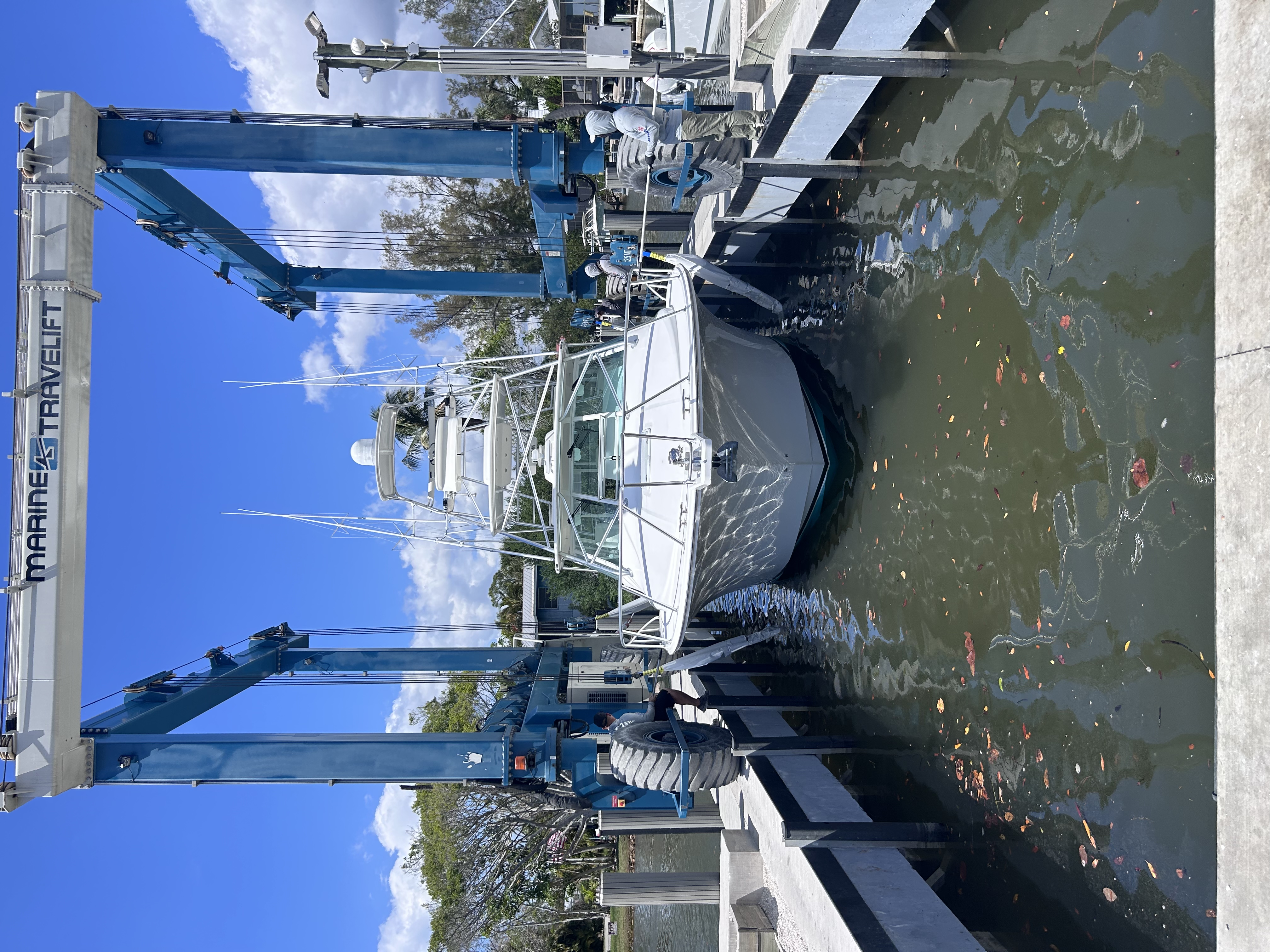
Annual haul and bottom service. Around $5,000 for a straightforward yearly haul, block, bottom paint and launch on a wet-slipped boat.
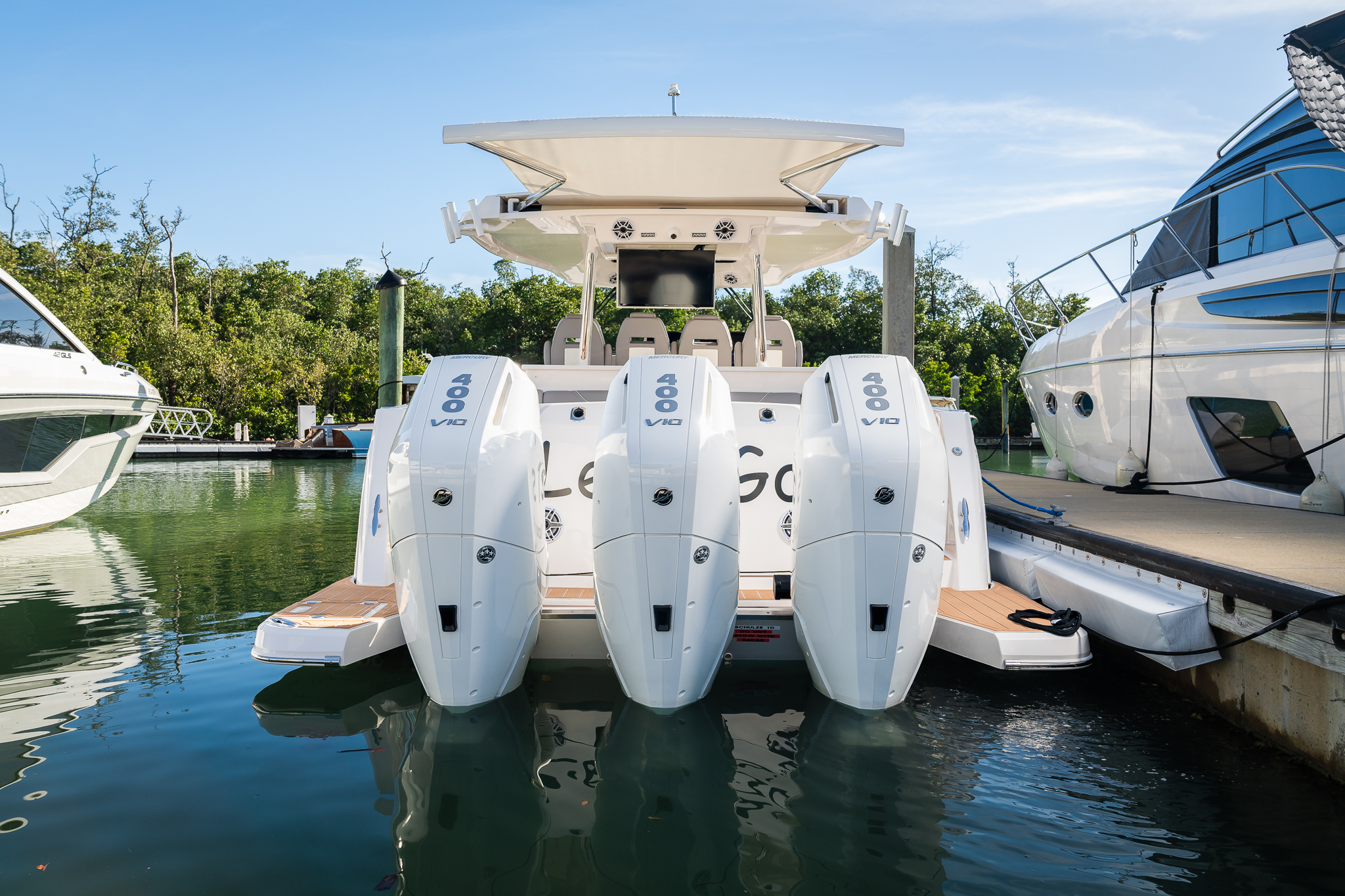
Routine mechanical service. Budget per engine, not per boat. A normal-year service on a 300-horsepower outboard runs $2,000–$3,000 or more. Twins, $4,000–$6,000. Triples, $6,000–$9,000. Larger diesels and major scheduled intervals go higher.
Cleaning and basic upkeep. $3,000–$6,000 a year depending on frequency and how much the owner handles personally.
That is roughly $23,000–$50,000 a year, before fuel, financing, depreciation, upgrades, hurricane expenses or anything unexpected. On a $300,000 boat, eight to seventeen percent. The rule of thumb is reasonable for what it measures. Buyers routinely mistake it for the whole picture.
Two things it leaves out entirely. The first is setup. Boats rarely arrive as the owner wants them. On one recent acquisition, the buyer spent roughly $69,500 in the first months — electronics, canvas, ceramic coating and factory upgrades — on a boat that cost $330,000. Twenty-one percent of purchase price, before a single ordinary year of ownership. The second is the periodic bottom event. Annual antifouling is one thing. Eventually a wet-slipped boat needs a strip and rebuild of the bottom and running gear. On a 35-foot sportfish at a Naples yard, that runs around $14,000. It is not annual. It is a five-figure event arriving every several years, and almost nobody plans for it.
Buyer Beware
Where you keep her forks the entire cost model. A wet slip means antifouling, growth, running gear treatment and eventually that rebuild. A lift or dry storage largely removes bottom paint from the equation but substitutes a storage cost — and a rented lift generally runs about the same as a wet slip. Only a lift behind a house you own is genuinely inexpensive. Two identical boats bought at the same price will cost meaningfully different amounts over five years on the strength of this one decision, which most buyers make on convenience and never revisit.
Purchase price is a poor measure of affordability. Two boats at the same number can carry very different annual costs depending on length, engine count, age, systems and storage.
Where you will keep her may be the harder problem
In some markets, the berth is a more difficult acquisition than the vessel. Naples is the clearest example I work in. As I write this, I know of a roughly 60-foot slip listed at $425,000 at one marina and a comparable one asking $599,000 a short distance away. Those are asking prices, not recorded sales. Most Naples marinas will not rent for less than a six-month commitment. The waiting list at one yacht club runs beyond five years — long enough that buyers occasionally purchase a current member's boat purely to inherit the slip, then sell the boat and buy the one they actually wanted. That is a market telling you something. A buyer can close in six weeks and then discover there is nowhere to put her.
Key Takeaway
Solve the berth alongside the boat, not after it.
Part II — Searching the Market Properly
The listing sites are the visible market and they are genuinely useful. They also require reading. Listings go stale. Price history matters more than asking price. Days on market indicates something, but not always what buyers assume. And "available" is not a fact until someone verifies it.
A portion of the market never appears there at all. I recently completed a transaction on a 2022 World Cat 32 DC that was never listed, never photographed for an aggregator, never publicly exposed. The seller was upgrading into another boat I was handling, which meant I knew her current vessel was becoming available before it existed as inventory. Separately, I had a buyer who had come to me about a different boat that, on examination, was not right for how he and his family intended to use it. I told him so rather than pushing the boat I had.
When the World Cat came free, the brief matched. It sold at $265,000 without ever going to market, inside the $260,000–$280,000 range I had given the seller. I represented both sides, disclosed to both, which is a subject I address separately in our representation policy.
Federico Perspective
"Off-market access" is close to the emptiest claim in yacht marketing, so here is the actual mechanism. There is no secret list. Every upgrade creates a boat coming out from under someone, and the broker handling the upgrade knows first. Years spent in yards, around service networks and inside transactions is what surfaces boats earlier than a search page does. The practical consequence for a buyer: searching harder does not find these boats. Being represented does.
Who works for whom
If you have bought a house, someone handed you a form explaining who your agent represented. Yacht brokerage has no equivalent. Florida licenses yacht brokers and regulates escrow and bonding, but there is no mandated disclosure putting representation in front of a buyer before they make an offer. So it is worth stating plainly: the broker listing a vessel works for the seller. They may be excellent. They are not representing your interests, and nobody is required to tell you.
Part III — Establishing What It Is Worth
Asking price is a position. Market value is a conclusion, built from sold comparables and adjusted for hours, service history, geography, equipment, condition and time on market.
How that analysis is actually built — and why asking price and market value are two very different numbers — is the subject of The Asking Price Is Not the Market: How Yachts Are Actually Valued.
What belongs here is the reason it matters at the moment of purchase. I represented a buyer on a leftover 2025 World Cat 325 CC listed at $385,000. New units were $425,000–$450,000, so the ask offered almost no discount on a boat that had already taken its first-year depreciation. Comparable inventory was thin, because the point in the year when the next model year rolls out is precisely when nobody transacts on leftovers. It closed at $330,000.
The reason I pressed for that entry price had little to do with winning a negotiation. I had listed a 2024 World Cat 295 CC that a client bought new at $365,000 and sold at $265,000 two years later. A hundred thousand dollars, twenty-seven percent, in twenty-four months.
Key Takeaway
The acquisition price is what determines whether the eventual sale is a loss or a wash. The goal is not to buy cheaply. It is to buy at a number that survives the next depreciation cycle.
Part IV — Structuring the Deal
An offer is more than a number
Terms, timeline, deposit, contingency structure and proof of funds all communicate something. So does speed. I had buyers who saw a boat, loved it, and took three days to decide. In that window it went under contract to someone else. Nothing clever happened — someone organised moved, and they were not. Being prepared in advance is what lets a buyer act in three days rather than need them.
The contract, and what the other side tells you
A purchase and sale agreement establishes the deposit into escrow, the survey and acceptance window, the closing date, and what happens to the deposit under each outcome. The contingency period is the buyer's protection, and it is only as good as the time it actually allows.
I had a deal on a 2012 MJM 36z Down East in Wisconsin, negotiated from $385,000 down to $360,000 before my client flew out. The boat showed well. He liked it. We submitted at the agreed number. Then the seller marked up the executed agreement by hand, changed terms throughout, signed it after my buyer had already signed, and compressed the timeline so tightly that we would have had to either rush diligence or waive the right to survey and sea trial.
I spent three or four days trying to make it work. When it became clear the other side would not give ground on the time we needed, I told my client to walk.
Buyer Beware
Nothing was wrong with that boat. What ended the deal was a seller whose conduct made the risk impossible to price. Buyers understand that a bad survey can kill a transaction. Very few understand that how the other side handles paperwork is itself a finding — and a reliable predictor of what the rest of the transaction, and the period after closing, would have looked like.
Shortly afterward we found him the same boat concept in a modern build: a 2022 True North 34 OE, ten years newer, in better condition, an hour from his home rather than a flight away. Note what did not change. The brief. He did not settle for something else — he got what he had wanted all along, from a boat that had not been compromised by the process of buying it. The fear that keeps buyers in bad deals is that this was the one. It rarely is.
Part V — Due Diligence
A marine survey, a sea trial and a mechanical or engine survey are designed to find different things, and each has structural blind spots. Engage them as three separate exercises, not one event.
Why each is necessary, what each can find, and what each will miss, is covered in Sea Trial vs. Survey vs. Mechanical Inspection.
Select your own surveyor — independent, accredited, familiar with your type of vessel. Then attend. Be at the haul-out. Be on the sea trial. A report read three days later is a summary of a day you should have witnessed.
One thing buyers are rarely told: on a brokered vessel you generally do not get a test drive before deciding. You get a showing, then you ride the boat on survey day, after you are under contract with a deposit at risk. Pre-purchase demo rides happen only when a seller specifically permits one.
What I watch on a sea trial
A surveyor's trial run captures figures: RPM against rated, speed, temperatures, systems function. That work matters and it is not the whole of what the boat will tell you. What I do as a captain is run her through the range — speeds, RPM, trim — and read four things. Sound, because engines tell you about themselves. Entry, whether she lands hard or soft. Response, whether she answers the input. And lag, the delay between what you tell her to do and what she does. That last one is the thing most buyers would never think to check and would absolutely feel on a bad boat without knowing why.
If the day is flat, I go looking for conditions — find traffic, cross the wake deliberately, and read where she lands, whether she recovers on one impact or keeps working, what the helm does through it, and whether anything shifts or bangs below. And when conditions cannot answer a question, the honest entry is not tested, never "fine."
Reading the report
Sort findings into safety, structural, systems, deferred maintenance and cosmetic. Understand which items must be resolved before insurance will bind — those are not negotiating chips, they are conditions of the deal happening at all.
How to work through a survey report in detail — what it finds, what it misses, and how to read its language — is the subject of Understanding Yacht Surveys.
Then read the language. On the Cabo 40 Express, a control alarm was logged during the trial with a recommendation to troubleshoot and replace as needed. A buyer reads that and pictures a sensor. It turned out to be the ECU and a connector, and the alarm would not clear until components were replaced. That work landed entirely on the buyer after possession. Nobody behaved badly. The seller cleared the items insurance required, the boat sold at full asking price because the comparables supported it, and the buyer proceeded with his eyes open.
Key Takeaway
Any finding written as diagnose, troubleshoot, monitor or replace as needed is an unpriced liability. It is not a defined cost. It is an open question, and the buyer inherits it at closing unless it is closed before. Decide consciously whether you are absorbing it rather than assuming somebody else will.
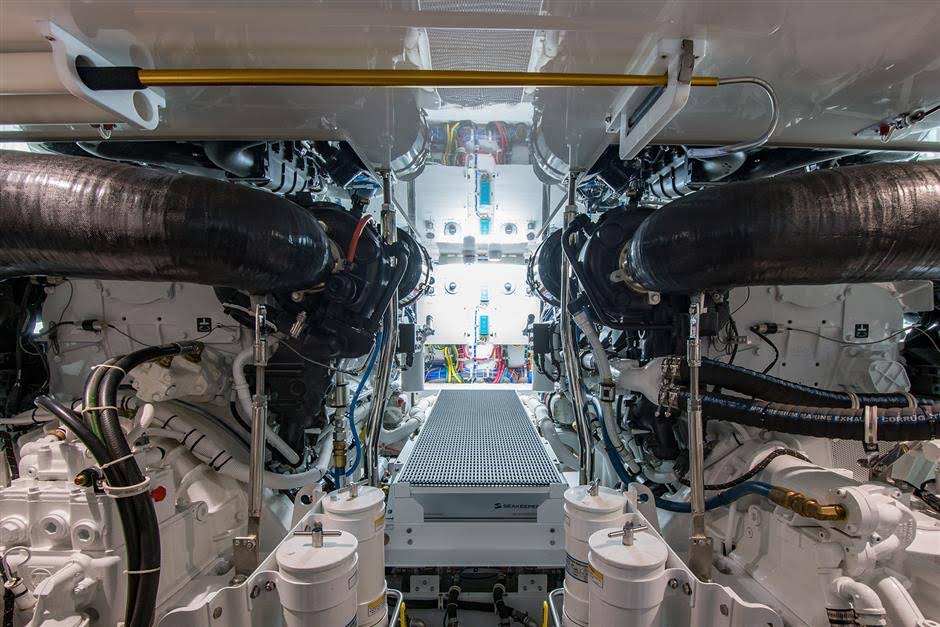
That is also where a coatings and corrosion background changes what a report means. Bottom paint condition, blistering, moisture readings and corrosion at fittings are not punch-list items. They are early indicators of what ownership will cost, and of that five-figure bottom event arriving sooner than expected.
Negotiating findings, and knowing when to leave
Repairs can be completed by the seller, credited, or reflected in price. A reasonable post-survey position addresses material findings. An unreasonable one reopens the whole negotiation and can lose a fairly priced boat.
Federico Perspective
A known, quantified risk you choose to absorb is a legitimate part of a good purchase. A situation where you are prevented from finding out what you would be absorbing is not a negotiation. It is a reason to leave.
Part VI — Closing, and the Handoff Nobody Plans For
Financing, insurance and documentation all have lead times and all interact. Lenders require survey. Underwriters may condition binding on specific findings. Documentation or state titling, registration and tax questions belong with a documentation agent and an accountant. Get them moving early; none of it accelerates well.
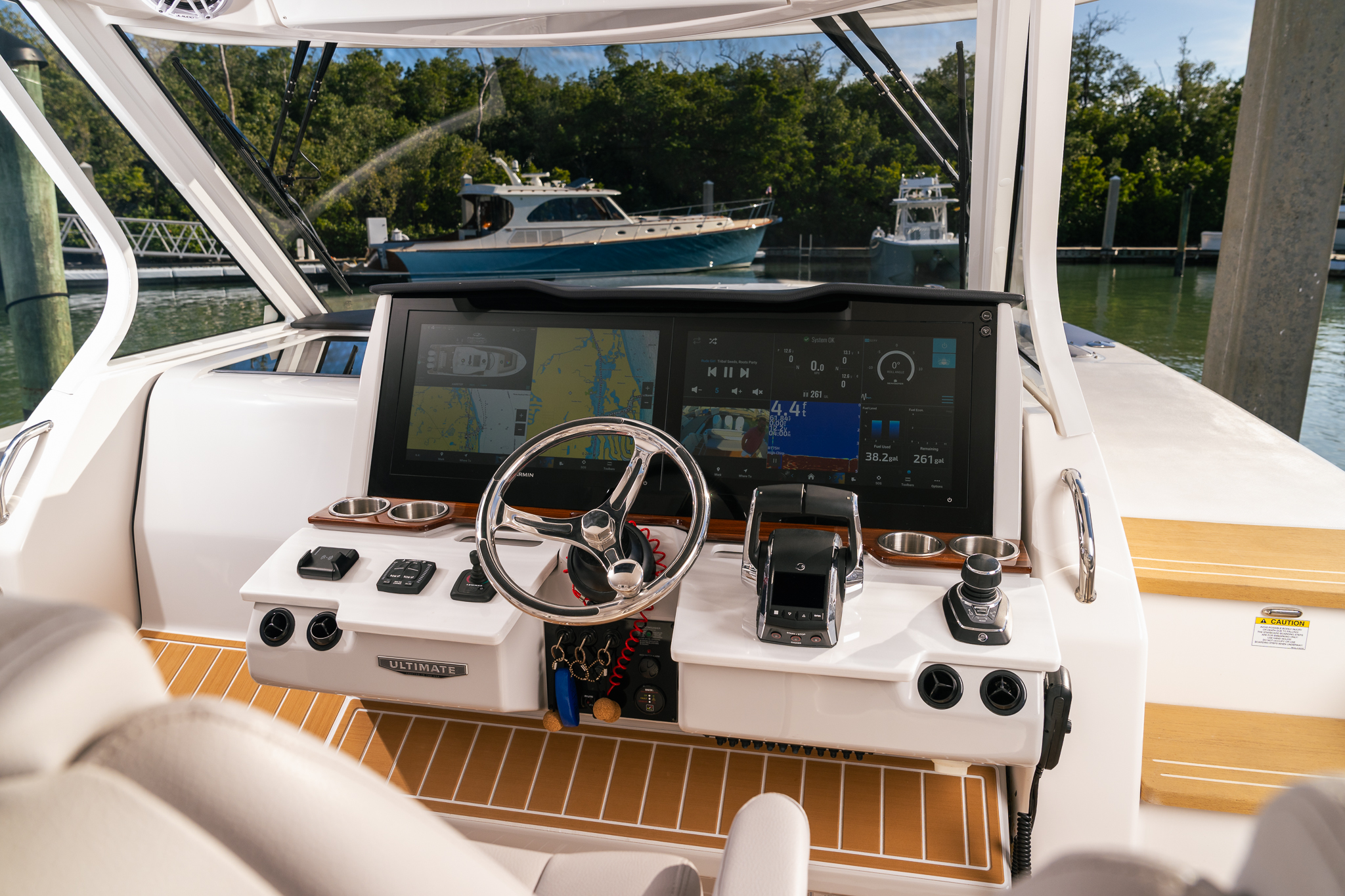
Then there is the piece most buyers, and a fair number of brokers, miss. Everything on a modern boat is a subscription registered to a person, not a hull. Satellite internet. Chartplotter ecosystems and their accounts. Anti-theft and tracking systems. Telematics. None of it transfers because a bill of sale did.
On one closing, the satellite system and chartplotter account were still tied to the previous owner. The vendors resolved it quickly once contacted; the seller was slow, because he had his money and no particular reason to hurry. It took about a week of calls. On another, a buyer took delivery in Alabama and went out for his first weekend. Alarms sounded and the boat would not come up past a certain RPM. The installed security system had not recognised the new owner and had concluded the vessel was stolen. Nothing was wrong with the boat. The fix was a phone call. But a new owner hours from the seller, family aboard, has no way to know that — he is assuming he just bought an engine problem.
Inventory every subscribed and registered system during the contract period and get transfers moving before funds change hands, while the seller still has every reason to cooperate. It costs nothing early and a week of phone calls late.
Part VII — The First Weeks
Closing is not the finish line. It is the point at which a boat becomes a known quantity.
What the first months should look like — transferring systems, establishing baseline condition, preservation, and actually using the boat — is covered in The First 90 Days of Yacht Ownership Take delivery deliberately..
Establish baseline condition. Get systems familiarisation from someone who knows the boat. Complete baseline service rather than assuming what the seller told you. Start records from day one. And make preservation decisions while the boat is still in known condition, rather than after a season has passed.
On one recent purchase, the owner and I went through the entire boat after delivery, addressed the survey findings, chased down electrical faults, had her detailed, fitted new canvas and added safety equipment, then hauled her within a couple of months for fresh bottom paint and running gear treatment. Then we ran her to his home port together. That is not extra service. That is where a purchase becomes a boat somebody actually enjoys owning.
What This Is Really About
Buyers underestimate this process because from the outside it looks like four steps. Every deal described here failed or succeeded somewhere between them — in a brief that was never interrogated, a berth nobody thought to secure, a line of survey language that sounded bounded, a seller's conduct during contract, a system still registered to a previous owner.
Representation is not about getting a buyer into a boat. It is about protecting their position throughout the deal, and making sure they still believe they made the right decision long after the transaction closed.
A note on sources: dockage figures cited as published are drawn from marina rate schedules and industry reporting current at the time of writing, and vary by location and season. Cost ranges presented without a published source are my own planning estimates based on transactions I have handled in Southwest Florida, and should be treated as professional judgment rather than quotes. Transaction examples are drawn from deals I have worked; clients and sellers are not identified. Nothing here constitutes legal, tax, insurance, engineering or survey advice — engage the appropriate specialist for each.
Considering a purchase? A Private Yacht Search begins with the brief, not the inventory.
Federico Yachts · Yacht Intelligence. Personal Representation. · captain@federicoyachts.com · +1 (239) 330-2505 · FedericoYachts.com
Private Yacht Advisory
Make the Next Decision With Better Information.
Whether you're buying, selling or evaluating your next move, Federico Yachts brings transaction experience, market intelligence and hands-on vessel knowledge to the decision.