Federico Intelligence
Ownership · 9 min read
Yacht Preservation: Protecting the Asset, Not Just the Finish
Years of coatings, restoration and brokerage have changed how I think about preservation. This is not really about ceramic coating, wax, polish or detailing. It is about preserving the underlying asset.
I think about preservation differently than I did when I started detailing boats.
Years of working around vessels as a captain, a restoration and coatings professional, and now as a broker have let me see the full cycle. I have corrected severely oxidised gelcoat, restored neglected metals, installed multiple ceramic and corrosion-protection systems, maintained boats that live outside year-round — and then stood on those same boats years later, alongside buyers and surveyors, watching what condition tells people.
That sequence changed my thinking. This is not really a subject about ceramic coating, wax, polish or detailing.
It is about preserving the underlying asset.
What the Environment Actually Does
In South Florida the environment is relentless, and a boat does not have to leave the dock to deteriorate. UV, salt, heat, humidity, hard water and airborne contamination work on it every day it sits.
Gelcoat shows it first. An owner notices lost gloss, then fading in the darker colours, and eventually a chalky, visibly oxidised surface. By that point protection alone is not enough — the damaged surface has to be corrected before anything can be applied over it. Depending on severity that means compounding, multiple polishing stages, sometimes sanding before polishing.
Which brings up the thing I most wish owners understood.
Key Takeaway
Every aggressive correction removes material. Gelcoat is finite. If a surface is allowed to fail every few years and then compounded back each time, eventually there is less to work with — and no amount of skill restores what has already been polished away. You cannot endlessly restore a surface that is continually allowed to deteriorate.
Paint demands even more restraint. Around painted surfaces I want to know exactly what system I am dealing with and how much correction it can tolerate. I have seen more damage created by people trying to fix the environment's damage with overly aggressive products than by the environment itself.
Glass is a quieter version of the same story. Salt and mineral deposits that would have wiped off easily become progressively harder to remove after being allowed to dry and bake on repeatedly.
Fabrics, vinyl and stitching deteriorate most quietly of all. UV, sunscreen, body oils, moisture and mildew change their appearance and feel gradually enough that nobody notices until replacement is closer than restoration.
Corrosion Is the Most Underestimated Problem I See
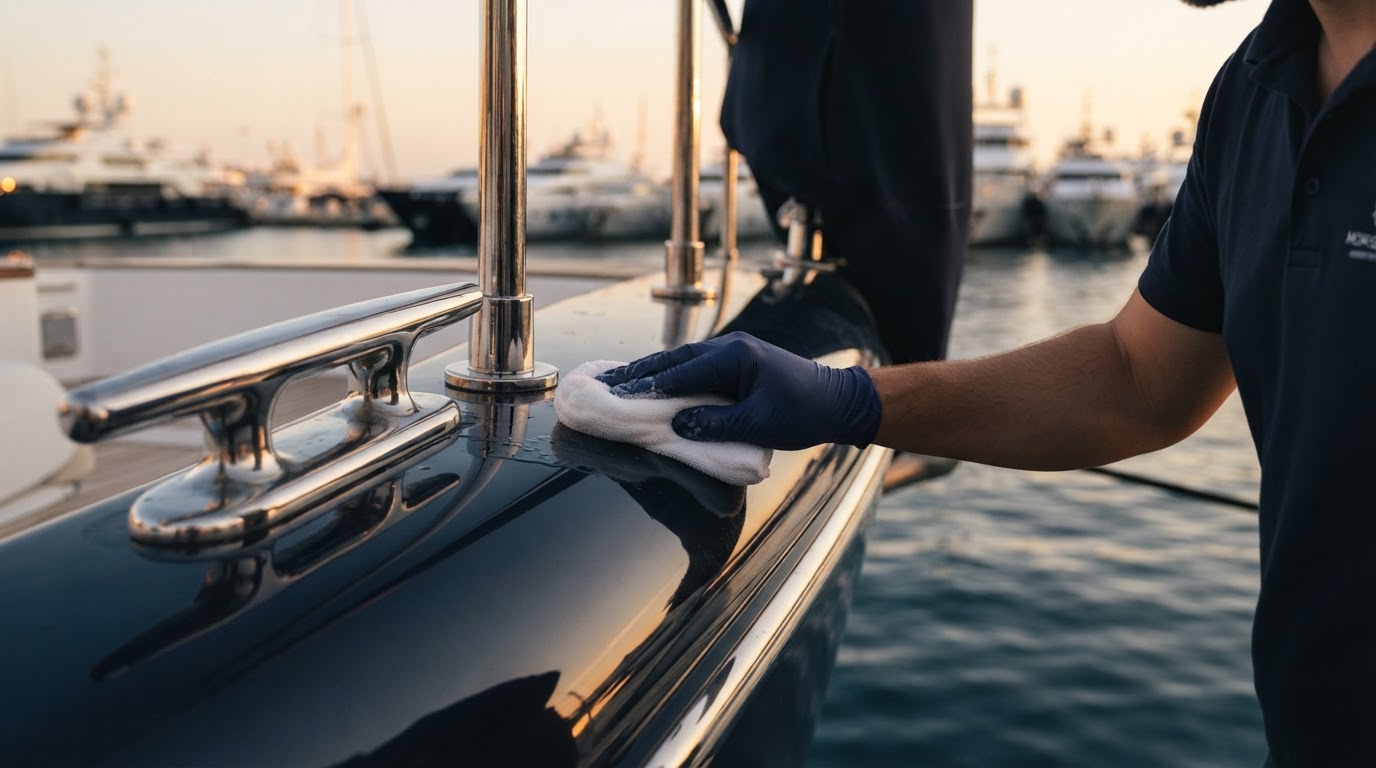
Working on boats in saltwater has made me acutely conscious of corrosion — around stainless hardware, fasteners, hinges, railing bases, aluminium components, powder-coated surfaces, electrical connections, and anywhere dissimilar materials meet.
The mistake owners make is waiting until it is visually significant.
A little staining around stainless hardware looks cosmetic. Slight bubbling under powder coat looks minor. But corrosion frequently progresses underneath and behind the surface, where you cannot see it. By the time it is obvious, you may be dealing with deep pitting, coating failure, or corrosion spreading beneath powder coat.
Federico Perspective
That is the line between preservation and restoration, and it is the most important distinction in this entire subject. Preservation is relatively inexpensive. Restoration usually is not. I am far more interested in preventing corrosion from developing than in repeatedly polishing away the evidence after it has started.
Ceramic Coating Is Excellent, and It Is Oversold
I install ceramic coatings and believe in them. I also think ceramic is one of the most oversold products in the marine industry, and owners deserve a straight account of what it does.
Ceramic does not make a boat maintenance-free. It does not make gelcoat scratch-proof. It does not prevent dock damage. It does not eliminate water spotting. It does not mean you can stop washing the boat. And applied over a poorly prepared surface, it does not make that surface healthy — it locks in whatever condition was underneath it.
Where ceramic genuinely earns its cost is as a sacrificial protection system over a properly prepared substrate.
When I restore a boat, nearly all of the work happens before the coating comes out. Wash, chemical decontamination, correction, compounding, sometimes sanding, polishing, careful preparation. Only when I am satisfied with the substrate do I want to lock that condition in.
Buyer Beware
The quality of a coating job is determined almost entirely by what happened before the coating was applied. If someone is selling you the bottle rather than the preparation, you are buying the least important part of the process.
Ceramic, sealant or wax
I do not recommend ceramic for every boat.
Wax produces tremendous gloss and real sacrificial protection, and in this environment I expect it to need frequent maintenance.
A quality sealant is an excellent middle ground — meaningful protection without the expense and preparation of a full ceramic installation. I reach for sealants often.
Ceramic is what I want when we are starting from a properly corrected surface and the owner is committed to a longer-term preservation strategy.
The decision depends on the boat, its condition, how it is stored, how it is used, and above all how the owner intends to maintain it afterward.
Key Takeaway
I would rather see a boat consistently washed and protected with a good sealant than see an owner spend thousands on ceramic and neglect it afterward. Consistency beats the product label.
What a Real Protection Program Looks Like
I do not believe in coating a boat and saying "see you in three years." Not here.
Protection has to be managed. It starts with proper washing and salt removal, and it continues with regular inspection of metals, glass, gelcoat, paint, non-skid and upholstery. The objective is to catch the beginning of a problem rather than the end of one.
If contamination is building on a coating, remove it. If stainless is beginning to stain, address it. If water spotting appears on glass, do not let it sit for six months. If protection on a heavily exposed area is weakening, service it before the substrate starts to go.
At minimum, have the exterior condition professionally evaluated once a year, with ongoing maintenance dictated by how the boat is actually responding to its environment.
Cost varies enormously, and condition drives it more than length does. As a reference point, ceramic coating on a recently purchased centre console in the 32-foot range ran $9,000 as part of that owner's initial setup. A consistently maintained boat may need relatively minor correction and protection. The same boat neglected for several seasons might require sanding, multiple correction stages, metal restoration, glass restoration and substantially more labour before protection is even worth applying.
Key Takeaway
You can pay to preserve a boat gradually, or you can eventually pay to restore it all at once. The second number is always larger.
The Small Things That Quietly Destroy Boats
Very few boats are cosmetically ruined by one catastrophic event. They are ruined by hundreds of small ones:
Letting salt dry repeatedly. Leaving hard-water spots on glass. Reaching for aggressive chemicals because they clean faster. Using the wrong brush on sensitive surfaces. Compounding gelcoat every time it loses gloss. Ignoring the first signs of corrosion. Letting powder coat continue to bubble. Leaving sunscreen and body oils on upholstery. Allowing moisture to stay trapped under cushions. Waiting until oxidation is obvious before doing anything at all.
Underneath most of these sits a single misconception: that if something can be polished back, no permanent damage occurred.
It is not true. Every correction spends material you do not get back. My goal is always the least aggressive correction that will do the job, and then preserving the result for as long as possible.
Seeing These Boats Through a Broker's Eyes
I have stood on enough boats with enough buyers to know exactly what neglect looks like from their side. You come aboard and start noticing things. The gelcoat has no depth. Dark surfaces are faded. Stainless is staining around hardware. Powder coat is bubbling. Glass is heavily spotted. Caulking looks tired. Non-skid is holding contamination. Vinyl is discolouring.
No single one of those makes a boat bad. Together they tell a story, and I have watched buyers arrive at the same question every time:
Federico Perspective
If this is how the owner maintained everything I can see, how did they maintain everything I cannot? That is the moment cosmetic condition stops being cosmetic. It starts affecting confidence in the boat itself — in the systems, the service history, the things a survey has one day to find.
A well-preserved boat communicates the opposite before the engines are ever started. Clean metals, healthy gelcoat or paint, clear glass, properly maintained upholstery and documented preservation work all say the same thing about the owner. Buyers read it accurately, because it is usually true.
Two years is enough for a maintained boat and a neglected one to look like different vessels. The frustrating part is how much of that difference was preventable. I have spent days sanding and correcting boats that consistent protection would have kept in condition. I have dealt with corrosion that would have been trivial when it first appeared. I have restored glass that should never have been allowed to get that far.
Condition Protects Value
I do not tell owners that a ceramic coating adds a specific amount to their resale number. That is the wrong way to think about it, and anyone promising it is guessing.
Condition protects value. Coatings, corrosion protection, sealants, proper washing, correction and routine maintenance are simply the tools for holding condition.
Be clear about what that means, though. Condition protects your position relative to comparable boats — a well-kept vessel sells faster and closer to its ask than a tired one of the same age and model. It does not defeat depreciation, and it cannot rescue a boat that was bought above the market. I have listed immaculate boats that still sold well below what their owners paid. Preservation protects the position you bought into. It does not create a new one.
How that acquisition position is established, and what actually moves a resale number, is covered in Protecting Resale Value From the Day You Take Delivery.
A yacht is a collection of expensive systems and expensive surfaces, living in one of the harshest environments we routinely put valuable assets into. The work is not about selling someone a bottle. It is about understanding what each surface needs, intervening before deterioration becomes restoration, and preserving an asset somebody has put a great deal of money into.
The best preservation work I have done is usually work a future buyer will never know happened. They simply step aboard years later and think: this boat has been exceptionally well cared for.
That is the entire goal.
A note on sources: cost figures reflect specific projects and vary substantially with vessel condition, size and construction. Observations here are drawn from hands-on restoration and coatings work and from vessels evaluated in the course of brokerage. Nothing here constitutes engineering or survey advice — engage the appropriate specialist for coating systems, corrosion assessment or structural questions.
Planning ahead? Preservation decisions made at acquisition are worth more than the same decisions made at resale.
Private Yacht Advisory
Make the Next Decision With Better Information.
Whether you're buying, selling or evaluating your next move, Federico Yachts brings transaction experience, market intelligence and hands-on vessel knowledge to the decision.